
On a recent trip to Sicily, we spent a morning outside the hilltop town of Agrigento, walking among the remains of Akragas. Greek colonists from Gela founded it around 580 BC. Fertile plains and Mediterranean trade made it rich fast. Some called it the most beautiful city of mortals. Philosopher and native of Akragas, Empedocles, reportedly said his neighbors ate as if they would die tomorrow and built as if they would live forever.
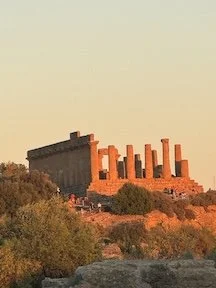
Within two centuries, Akragas had cycled through tyrants, wars, and finally a Carthaginian siege that left it sacked in 406 BC. You can still see the scorch marks on the stone.
What struck me wasn't the story. It was how familiar it sounded. Our guides in Sicily told versions of it we had already heard in Rome, Florence, and Turkey. Different names, same arc: rise, excess, rot, collapse. And I kept thinking about the companies I've watched follow the same script.
The pattern starts with success, not villainy
Researchers spent four years studying fallen companies and found five stages: hubris born of success, undisciplined pursuit of more, denial of risk and peril, grasping for salvation, and capitulation. The sharpest insight is that an institution can be sick on the inside while looking strong on the outside, until the trouble seems to arrive all at once.
Odd, that corruption isn’t first on the list. Akragas’ golden age came under tyrants, but fell as a wealthy, neutral democracy whose citizens had grown too comfortable, indicating that complacency may be the real issue.
So, is it tyranny that leads everyone over the cliff? Sometimes. More often, it's quieter. It’s leaders who begin serving themselves rather than the enterprise, and followers who stop asking questions, allowing a small group of insiders to squeeze value from everyone else. Growth under them can be impressive but rarely lasts, because the people on top have little incentive to reform what benefits them. Swap "politicians" for "executive team," and the lesson travels well into government or a boardroom.
Bread and Circuses
"Bread and circuses" comes from the Roman satirist Juvenal. This typically refers to rulers pacifying the masses with free grain and gladiator games. (A more current version might be UFC fights on the White House lawn and sending checks to people prior to an election.) That's only half of Juvenal’s point. His real target was the citizens: a people who once played an active role in government and now cared about just two things. Distraction only works on an audience willing to be distracted.
The corporate version rarely involves gladiators. It's the splashy rebrand, the visionary offsite, the all-hands celebrating a new logo while the runway shrinks. In September 2001, Ken Lay told Enron employees in an online forum that the company would hit its numbers and that the stock was incredibly cheap. According to the federal indictment, over the prior two months, he had bought $4 million of Enron stock while quietly selling $24 million. Three weeks later, Enron reported a $618 million quarterly loss. By December, it was bankrupt.
How often does this happen? No one can count every cover story, but the iceberg is large. It is estimated that in an average year, 41% of public companies misrepresent their financial reports, and that only about a third of frauds are ever detected. And distraction measurably works. In fact, markets react far more weakly to a company's earnings news on days crowded with other announcements. Attention is finite, and leaders who want something to go unnoticed know when to release it.
What to watch for when decline is hidden
Words and actions diverge - Watch what insiders do with their own money and loyalty, not what they say at the podium.
Spectacle rises as substance falls - More announcements, fewer clear numbers.
Metrics keep getting redefined - "One-time" adjustments that show up every quarter.
Bad news travels slowly, and messengers pay - Lay's reassurances came more than a month after a vice president had warned him about the accounting.
The best people leave quietly - Growing beyond your ability to fill key seats with the right people sets up the fall.
Gradually, then suddenly
In Hemingway's The Sun Also Rises, Mike Campbell is asked how he went bankrupt. "Two ways," he says. "Gradually and then suddenly." That is the arc of Akragas, of Enron, and of most declines I've seen up close. The gradual part is a long string of small accommodations: a number shaded, a question unasked, a warning explained away. The sudden part is simply the day the accumulated cost becomes visible.
It applies to individuals too. Careers, health, and relationships rarely collapse in a day. They erode through choices we tell ourselves don't matter, while we enjoy our own bread and circuses.
My view: corrupt leaders get the headlines, but decline requires accomplices. Boards that don't press, managers who repeat the talking points, employees who prefer the show to the truth. Juvenal blamed the crowd, and he had a point.
Ask yourself this question: when you've been inside an organization that was quietly declining, what was the first signal you noticed, and what did you do about it?