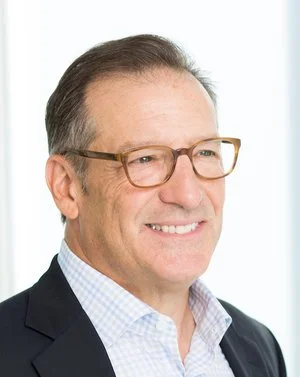
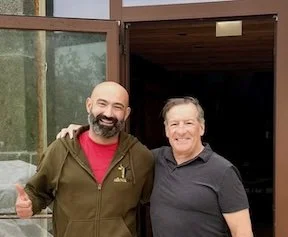
Giuseppe Grasso and me at Alleva.bio
On a recent trip to Sicily, I had the pleasure of meeting Giuseppe Grasso. His farm, Alleva.bio, sits in the hills of the Iblei Mountains outside Vizzini. He runs it with his wife, Romina, a veterinarian. They raise Modicana and Sicilian cattle, black pigs, Sicilian chickens, and Oriental horses, all ancient local breeds they are working to preserve. They grow wheat, vegetables, and fruit, and produce their own olive oil and cheese. Every acre is certified organic. Everything is made in small quantities, on purpose. They also host small groups who want to immerse themselves in how a farm like this actually works.
Giuseppe didn't plan to be a farmer. He left for university to study economics, then came back to the family business he now calls "an antidepressant." As he put it: "Each day I wake with purpose and I enjoy what I do."
Then he said something that caught my attention.
He was explaining how the farm evolved into what it is today. One of his best friends growing up had left Sicily to go to school in America. He attended Babson College. After a successful career in finance, the friend came home. The two of them sat down to talk about the farm, and after a while the friend said: "Giuseppe, you have all the ingredients, but you need a recipe."
That conversation, Giuseppe said, is how the farm became what it is today.
I taught at Babson for 17 years. When I told him, Giuseppe was stunned. His friend was the only other person he had ever known from the school. I never had his friend as a student. I don't know who did. But I know the classrooms he sat in, and I recognized the advice the moment I heard it.
The butterfly effect
Chaos theory calls this the butterfly effect: a tiny change in one place can reshape outcomes far away, in ways no one can trace back to the source. Giuseppe's friend was the butterfly. A few words of advice to a childhood friend altered the trajectory of a family farm.
That is the uncomfortable reality for anyone who teaches, coaches, or leads. The influence is real. It is also almost entirely invisible to the source.
Network research gives that invisibility some shape. Researchers found that behaviors and emotions spread not only to our friends but to our friends' friends and to their friends, roughly three degrees out before the effect fades. By that measure, Giuseppe sits two steps from a Babson classroom. Every guest who leaves his farm thinking differently about food sits at three.
Now multiply that. Babson counts tens of thousands of alumni working in 128 countries. I taught many of them. I will never know what most of them did with what we discussed, or who they passed it to, or in what language.
A mindset, not a curriculum
Babson has been ranked No. 1 in entrepreneurship by U.S. News & World Report for more than three decades. Rankings are nice. This is better.
What Giuseppe's friend gave him wasn't a business plan or a financial model. It was a way of seeing. Start with what you already have. Saras Sarasvathy's research on how expert entrepreneurs actually think calls this the "bird in hand" principle: begin with who you are, what you know, and whom you know, rather than setting a goal and then hunting for resources. Giuseppe had land, ancient breeds, a partner who is a veterinarian, and generations of family knowledge. His friend didn't add ingredients. He showed him they were already on the table.
For a school fiercely dedicated to global entrepreneurship, this is the ultimate validation. It proves that the Babson methodology isn't just an academic curriculum taught in Wellesley, Massachusetts. It is a viral, borderless mindset that changes lives in rural Sicily through simple word of mouth.
No one at Babson will ever list Alleva.bio as an outcome. No alumni survey will capture it. The proof showed up by accident, on a farm in the Iblei hills, in front of the one person who could recognize it.
How this changes my thinking
I'll own something. For much of my time in the classroom, I measured impact the way institutions do: course evaluations, placement numbers, the startups that made the alumni magazine. Those were the waves I could see. I underweighted the ones I couldn't: the offhand comment after class, the framework a student repeats to a childhood friend a decade later, half a world away.
I have come to realize that the most important work leaders, teachers, and coaches do is work they will never get credit for, and they should do it anyway. If you only invest where you can see the return, you will invest in the wrong things.