We are living in a second Gilded Age, and the lessons of history are once again being ignored.
America's top 1% now accounts for nearly 32% of the nation’s total wealth. The bottom 50% hold 2.5%. Income inequality has reached a 60-year peak. We have more billionaires and millionaires, and now our first trillionaire, than at any prior moment in human history. Yet the dominant ideology of corporate leadership still traces its intellectual lineage to a single newspaper essay published in 1970.
In "The Social Responsibility of Business Is to Increase Its Profits," Milton Friedman argued that the corporate executive is an agent of the shareholders and that spending company resources on social causes amounts to spending someone else's money without their consent. This became the Friedman Doctrine, the philosophical backbone of shareholder primacy for the next half-century.
But here's what most people get wrong: even Friedman included a caveat. His actual words were that business should pursue profit "while conforming to the basic rules of society, both those embodied in law and those embodied in ethical custom." That clause has been almost universally ignored. What spread wasn't Friedman's full argument; it was a bumper-sticker version of it.
We Have Been Here Before
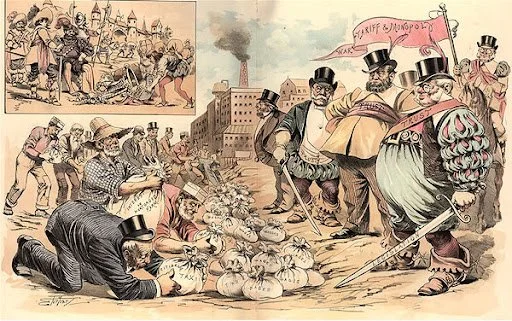
A century ago, the United States was navigating a strikingly similar moment. The Gilded Age had produced extraordinary concentrations of wealth alongside unsafe working conditions, unaffordable housing, exploited immigrant labor, and a widening chasm between the powerful and everyone else. The robber barons were not inherently villains; many were brilliant builders, but unchecked, their enterprises had begun to devour the society that made them possible.
Theodore Roosevelt understood this. His Square Deal wasn't anti-business; it was pro-society. He broke up trusts not because he opposed enterprise, but because he believed no private interest should be allowed to undermine the public good. In 1908, he denounced "representatives of predatory wealth" guilty of "all forms of iniquity from the oppression of wage workers to unfair and unwholesome methods of crushing competition." His position was simple: a leader's responsibility extends beyond those who profit from the enterprise to those who make it possible and to those who live within the society it shapes.
We are now in the middle of what economists call a K-shaped economy, in which the top arm of the K rises steeply while the bottom arm continues to fall. High-income Americans are prospering. Working Americans are watching prices outpace wages, jobs disappear, and opportunities contract. The shape of the K is not an accident. It is, in part, the consequence of a generation of leaders who answered the question "Who am I responsible to?" with one word: shareholders.
The Pledge That Changed Nothing
In 2019, 181 CEOs signed the Business Roundtable's Statement on the Purpose of a Corporation, formally repudiating shareholder primacy and committing to lead for the benefit of all stakeholders, including employees, customers, communities, and shareholders. It was a significant symbolic moment.
It was also largely empty. Subsequent research found that the vast majority of the signatory companies' boards had never been asked to approve signing. Most governance documents remained unchanged. A majority explicitly reaffirmed shareholder primacy. The statement was a press release masquerading as a paradigm shift.
Compare that to R. Edward Freeman, the UVA Darden professor who first articulated stakeholder theory in 1984 and has spent the past four decades making the case that creating value for customers, employees, suppliers, and communities is not in conflict with creating value for shareholders; it is the mechanism by which durable shareholder value is created. The leaders who understood this built institutions that outlasted them. The ones who didn't built extraction machines.
The Question Leaders Are Avoiding
Here is what I keep coming back to: Can a leader claim success while the community where their employees live becomes unaffordable? Can they claim integrity while optimizing algorithms that erode teenagers' mental health or adults' discourse habits in the name of engagement metrics? Can they call it "creative destruction" when the destruction is borne entirely by workers who had no seat at the table when the decision was made?
Would it be better for leaders to adopt a broader lens: What does this decision do to the people who work here? To the customers we serve? To the community in which we operate? To the world our children will inherit?
This is not the thinking of social democrats. It is long-term thinking that captures the broader message Milton Friedman intended to convey. And right now, we are suffering from a catastrophic shortage of forward-thinking leaders.
True leadership requires accountability to a broader constituency: employees, customers, communities, and yes, shareholders, not because it's idealistic, but because it's the only model that sustains an enterprise and society over time. The evidence is clear. What is lacking is the will to act on it.
Angelo Santinelli is an executive coach and advisor to CEOs, founders, and senior executives at PE- and VC-backed companies.
Sources:
Friedman, Milton. "A Friedman Doctrine: The Social Responsibility of Business Is to Increase Its Profits."New York Times, September 13, 1970.
Friedman Doctrine — Wikipedia (for the nuance on what he actually wrote vs. how it was applied)
Business Roundtable: "Redefines the Purpose of a Corporation" — August 2019 statement
HBR: "The Business Roundtable's Stakeholder Pledge, Five Years Later" — Harvard Business Review, August 2024
CNBC: "Wealth Inequality and the K-Shaped Economy" — January 2026
R. Edward Freeman — UVA Darden School of Business / Stakeholder Theory at 40 Years